
引 言
液滴撞击底板后沿着径向迅速铺展,铺展行为主要由惯性力驱动,受毛细力和黏性力约束,一般用无量纲参数$We$数($We = \rho u^2D_0 / \sigma$;其中$\rho$,$u$,$\sigma$分别为密度、撞击速度和表面张力)和$Re$~($Re = \rho uD_0 / \mu$;其中$\mu$为动力黏性系数)来表征.一定条件下,液滴撞击底板后会发生破碎现象,而破碎是否发生通常取决于$We$和$Re$的大小[5-7]. 研究液滴铺展时主要关心液滴能够达到的最大铺展直径($D_{\max})$,用最大铺展系数$\beta _{\max }$ (定义为$D_{\max}$和$D_0$之比)[8-9]来表示.基于一定假设,学者们提出了描述液滴铺展系数的标定律模型.当液滴铺展过程中黏性力占主导时,认为撞击的动能全部被黏性力耗散,则$\beta _{\max} \sim Re^{1/5}$~[10-11];当液滴的黏性较小,只考虑毛细力作用时,根据铺展过程中能量转化方式的不同又可划分为两种不同的标定律.如果下落的动能全部转化为液滴的表面能则满足$\beta _{\max } \sim We^{1 / 2}$~[12-13],如果下落的动能不仅转化为表面能还有液滴内部的流动则满足$\beta _{\max } \sim We^{1 / 4}$~[14-15].然而标定律只是对液滴铺展过程的粗略描述,基于能量守恒并考虑液滴铺展过程中接触角的动态变化过程Pasandideh-Fard[16]和Yukihiro等[17]提出了更为精细的铺展模型.另一方面,当液滴达到最大铺展半径后,在表面张力的作用下开始回缩并引起铺展半径减小,液滴与底板间的粘附力足够捕捉液滴时会使得液滴继续留在底板上,否则就会回弹离开底板.Mao等[18]研究了液滴撞击固壁后的铺展和回弹现象,并给出了预测液滴回弹的半经验模型,结果表明液滴回弹条件主要取决于液滴的最大铺展半径以及平衡时的静态接触角.另外,液滴在回弹过程中伴随着形状振动,液滴的黏性不断消耗其动能,从而影响液滴的回弹过程.Rayleigh最早提出了无黏液滴在真空中线性振动的数学模型[19],Lamb[20]则在1932年给出了液滴在介质中振动的线性通解.随后有研究通过实验[19,21-23]、数值模拟[24-25]和理论推导[26-27]方法对液滴和气泡在不同介质中的形状振动规律进行了广泛深入的研究.
然而,随着具有高导热系数的液态金属在传热领域和核电领域的广泛应用,以液态金属为流动介质的相关流体动力学特性的研究逐渐受到学者们的关注,液态金属的高表面张力(通常为水8倍左右)使得其两相流动将表现出一些不同的特性.金属熔点通常较高,高温液态金属铺展过程常伴随相变产生.Dhiman等[28]研究了大$We$下高温液态金属锡撞击固壁后产生溅射现象的条件.当底板温度较高时液滴边缘凝固速度慢,液态金属在铺展过程中受到的阻力较小能够充分铺展,基本没有溅射现象;当底板温度较低时液滴边缘凝固速度快,因此液滴边缘的铺展被大幅抑制内部多余的动能通过溅射出的液滴释放.常温下为液态的金属非常有限,水银是其中之一,Avraham等[29-30]研究了室温下水银在薄的银质和金质底板的铺展过程,结果表明水银在铺展的同时和底板发生化学反应,并且在反应达到一定程度后会在底板内部扩散进而达到更大的铺展半径.相比于复杂的化学反应铺展,Yang等[31]研究了常温下为液态的镓铟锡液滴在水平磁场作用下的铺展特性,当撞击速度较小时(0.1~1.2 m/s),在水平磁场的作用下液滴铺展呈现为各向异性,即沿着磁场方向的铺展受到抑制而垂直于磁场方向的铺展得到加强.然而,目前关于固体表面特性对金属液滴铺展影响的相关研究甚少,只有Shakeri等[32]讨论了熔融状态下的锡液滴在不同粗糙度的不锈钢表面铺展,但实验中用到的液态锡温度很高(246\textcelsius),在240\textcelsius的不锈钢表面铺展时几乎不受粗糙度的影响,而在常温(25\textcelsius)底板上铺展虽受粗糙度影响,但其中涉及相变问题,与不考虑相变的金属液滴铺展有较大差异,因此,对常温下液态金属开展相应的研究显得尤为重要.
本文对室温液态镓铟锡合金所形成的毫米级液滴在不同孔径的泡沫金属表面的铺展和回弹特性开展了详细的实验研究.首先对液态金属撞击固壁的实验系统及涉及数据处理方法进行了介绍,然后分别讨论了底板孔径和撞击速度对于液滴铺展形态的影响,最后通过衰减振动公式对液滴回弹后的振动频率特性进行详细的分析.
1 实验系统及数据处理方法
1.1 实验平台搭建
本实验所使用的流体为镓铟锡(GaInSn)合金,其中Ga:67%,In:20.5%,Sn:12.5%.室温下,镓铟锡合金呈现液态,无毒无味对人体没有危害,其具体物理属性见表1.开展液滴撞击铺展的实验系统简图如图1所示,存储于注射器中的液态GaInSn在微量注射泵的推动下经由导管到达固定在实验架上的不锈钢针头处(针头内径为0.25 mm,外径为0.5 mm),液滴不断在针头处聚集,形成直径为2.2 mm左右的球形液滴,并无初速度地脱落,最后撞击在其正下方的底板上并形成铺展.实验过程中通过改变针头与底板之间的间距来实现液滴的不同撞击速度.整个撞击铺展过程均采用高速摄像机(Phantom VEO 640S, 10 000 fps)进行记录.同时,为了较好地获得液滴在固体壁面的铺展特征,实验过程中始终保持相机视野中心与底板平齐.
| Melting point/°C | Boiling point/°C | Density p/(kg-m-3) | Viscosity v/(m2 •s-1) | Surface tension σ/(N•m-1) |
|---|---|---|---|---|
| 10.5 | > 1300 | 6360 | 2.98x10⁻⁷ | 0.533 |
图1
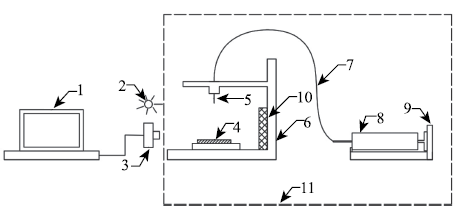
图1
实验系统简图
1-计算机;2-光源;3-高速相机;4-壁面材料;5-针头;6-实验架;7-软管;8-注射器;9-微量注射泵;10-平面镜;11-手套箱
Fig.1
Schematic of the experimental system
1-computer; 2-light; 3-high-speed camera; 4-solid plate; 5-needle; 6-supports of experimental system; 7-tube; 8-injector; 9-syringe pump; 10-mirror; 11-glovebox
由于GaInSn在有氧环境中极易被氧化并在其表面形成一层氧化膜,该氧化膜呈现出凝胶的特性并使得GaInSn的液体属性产生变化[34],主要表现为:表面张力的增大以及对于固壁润湿性的增强[35].实验表明[34]~GaInSn合金只有在氧含量低于1 ppm的环境中不会被氧化.因此,本实验中为了尽量避免GaInSn氧化现象的产生,整个液滴产生装置以及液滴铺展和回弹实验过程均在密闭的氩气环境手套操作箱中进行,且箱内设定压力与大气压力保持一致(实验台示意图见图1所示).然而,受限于手套箱的体积,高速相机、光源以及计算机均放置于手套箱外.本实验采用背面投影拍摄法来实现对液滴实时轮廓的获取,其中置于手套箱外面的光源通过平面镜10的反射来提供背光,而相机则可直接通过可视窗来拍摄液滴的瞬时投影形态.
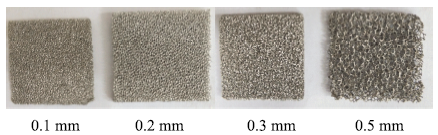
实验中用到的底板为光滑镍板以及不同孔径的泡沫金属镍,如图2所示,泡沫金属的孔径分别为0.1 mm,0.2 mm,0.3 mm,0.5 mm. 为方便描述,本文采用无量纲孔径$d = d_1 / D_0$,其中$d_1$为底板的孔径,$D_0$为液滴的平均初始直径($D_0 \approx 2.167$ mm). 计算得到无量纲孔径分别为0.046,0.092,0.138,0.231.为了更好地进行对比实验,实验中选择4种相同孔隙率(95%)的泡沫金属.
图2
1.2 数据处理方法
实验过程中,由于没有氧化的产生,针头产生的GaInSn液滴均能保持较好的球形.在液滴的下落过程中,由于表面张力和重力的作用,液滴一般会产生振动现象.然而,由于本实验的液滴尺寸小于毛细长度($l_{\rm c} = \sqrt {\sigma / \rho g}$,对于镓铟锡而言,$D_0 < l_{\rm c} \approx 2.924$ mm),可忽略液滴下落过程振动对实验结果的影响.本文采用投影法测液滴铺展,用MATLAB图像处理技术获得投影圆所包含的像素点面积,进而根据球体截面面积公式计算液滴的初始直径.图3(a)为98组实验中统计得到的液滴初始直径$D_{0}$.由于在实验过程中,当液滴撞击速度较大时,需要增大相机视野来获得液滴的整个铺展回弹过程,因此对应图3(a)中存在两种图像分辨率的液滴直径测量结果.其中1~43组实验(图3(a)方格)采用的图像空间分辨率为0.025 mm/pix,44~98组实验(图3(a)圆点)采用的图像空间分辨率为0.033 mm/pix. 经过统计分析得到,液滴的直径基本落在2.1~2.3 mm之间,为了方便无量纲参数的计算,我们后期均采用平均直径$D_{0}=2.167$ mm. 在误差方面,当图像空间分辨率为0.025 mm/pix时,直径的最大误差为2%,当图像空间分辨率为0.033 mm/pix时,直径的最大误差为3%.
图3
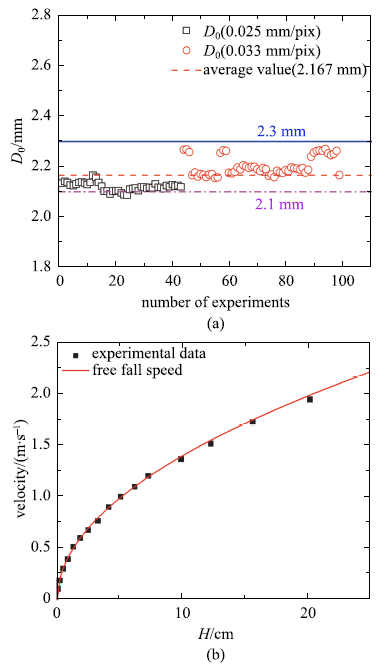
图3
(a)不同工况下液滴撞击固壁前的初始直径,其中空心方格为相机空间分辨率0.025 mm/pix时得到的液滴直径,空心圆是相机空间分辨率0.033 mm/pix时得到的液滴直径,虚线为平均初始直径$D_{0}=2.167$ mm;(b)液滴撞击速度与下落高度的关系图,点为实验值,曲线为自由落体理论值
Fig.3
(a) The measured initial diameter of droplets, the open squares and open circles represent measured diameters with spatial resolution of photo at 0.025 mm/pix and 0.033 mm/pix respectively. The dash line indicates the average diameter of droplets 2.167 mm; (b) The impact velocity of droplet compared with experiment data and free fall velocity theory
由于液滴在针头处无初速度自由下落,液滴撞击底板的速度主要取决于液滴下端距离底板的高度,在数据处理过程中,取液滴撞击底板前10帧图像计算所获得的平均速度作为液滴撞击底板的速度.图3(b)为实验测得的液滴撞击速度随下落高度的关系图,实验结果较好地符合自由落体高度与速度关系式,即$v = \sqrt {2gH}$.
进一步通过软件MATLAB的图像处理方法,我们获得了液滴的铺展半径和回弹高度随时间的变化以及液滴轮廓振动频率等信息.
2 实验结果和分析
2.1 底板孔径对GaInSn液滴铺展运动学特性的影响
图4为室温下液态GaInSn液滴撞击光滑镍板和不同孔径泡沫金属底板的铺展过程图.液滴在不同底板上的撞击速度均为0.6 m/s,对应的$We=9.3$,$Re=4363$.其中$t=0.0$ ms为液滴接触底板瞬间,此时液滴轮廓形状为圆形.随后液滴与底板作用产生变形,并且沿着径向迅速铺展.铺展过程中液滴初始动能被内部的黏性流动以及底板摩擦阻力所消耗.当铺展时间为$t=3.4$ ms左右,液滴达到最大铺展半径,铺展速度为零,对应动能为零.随后在表面张力作用下,液滴开始回缩并向中心聚拢,固液接触面积迅速减小.当铺展时间$t=6.0$ ms,液滴从中心位置上升,外部轮廓近似为圆锥形.
图4

图4
液滴以固定速度(0.6 m/s)撞击不同底板的铺展(3.4 ms之前)和回缩过程(3.4 ms之后)典型图片
Fig.4
Snapshots of droplet contours during the spreading (before 3.4 ms) and recoiling (after 3.4 ms) processes on different kinds of solid surface at fixed impact velocity, 0.6 m/s
底板特殊的孔隙结构会对液滴在底板上的润湿过程造成扰动,从而影响液滴的轮廓形状.液滴在光滑镍板上铺展轮廓受底板扰动较小,始终为对称铺展.液滴在无量纲孔径为0.046,0.092,0.138的泡沫金属上铺展时,达到最大铺展半径前不同孔径底板上液滴轮廓与光滑镍板近似都为对称铺展;在回缩阶段受底板结构的影响,液滴轮廓不再完全对称,表现为各向异性,并且随着底板孔隙增加液滴的不对称性更为显著.当底板无量纲孔径为0.231时,液滴撞击固壁后部分液体进入底板内部,因此在铺展阶段液滴的投影面积不断减小,直到底板孔隙部分饱和后液滴开始向中心聚集,逐渐从底板流出,对应相机获得的液滴投影面积增大.
通过对GaInSn液滴铺展轮廓的定量分析,将固定撞击速度下(0.6 m/s)液滴在不同底板的铺展系数(液滴和底板的实际接触直径与液滴初始直径之比)以及液滴中心位置轮廓高度随无量纲铺展时间$t^{\ast }(t^{\ast }=ut/D_{0})$的变化结果绘制于图5.在铺展系数随时间变化方面,从图5(a)中可以看出,在早期铺展阶段,惯性对铺展起主导作用,使得GaInSn液滴的铺展不受底板特性的影响[36],铺展系数与无量纲铺展时间呈现1/2次幂关系($\beta \sim \sqrt {t^\ast })$;随着铺展的持续进行,不同底板结构所引起的铺展系数差异逐渐显现出来.主要表现为:在较小无量纲孔径底板上(0.046,0.092,0.138),GaInSn液滴的铺展系数大于光滑镍板表面的铺展系数,且随着底板无量纲孔径的增大逐渐减小.这是由于当底板无量纲孔径较小时,GaInSn液滴在该种底板上表现出Cassie状态(疏水现象,具有较大接触角),且小孔的出现使得GaInSn液滴撞击底壁的瞬间更易在液滴和底壁之间形成一个较薄的空气层[37],减小了铺展过程的阻力,使得液滴能达到更大的铺展系数.而随着无量纲孔径的增大,这种空气层更加容易通过底板的多孔材料通道而消散,进而使得最大铺展系数逐渐减小.然而当无量纲铺展直径为0.231时,GaInSn液滴在该种底板表面呈现Wenzel状态(亲水状态,接触角较小)[38],且部分液滴进入底板的孔隙内部,使得铺展系数随时间变化趋势与其他结果完全不同,且由于液体在底板的渗透使得实际进行铺展的液体体积减小,进而极大地降低了液滴的最大铺展系数.
图5
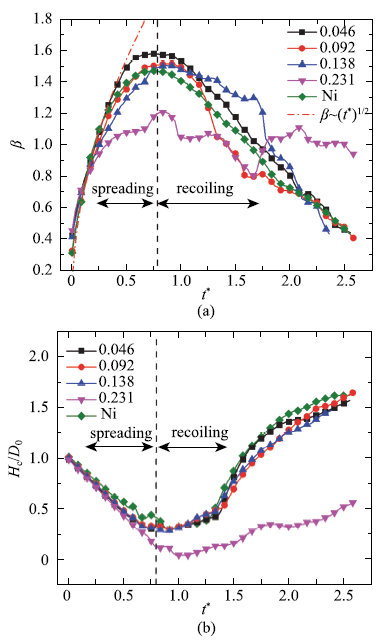
图5
液滴以固定速度(0.6 m/s)撞击不同底板的铺展系数(a)和相对中心轮廓高度(b)随时间的变化结果
Fig.5
The changes of spreading factor (a) and relative center height of contours (b) with time after droplets impacting on different kinds of solid surface at fixed impact velocity, 0.6 m/s
图5(b)给出了GaInSn液滴撞击底板后液滴相对中心轮廓高度(液滴中心距离底板高度(Hc)与液滴初始直径之比)随时间的变化过程.从图中可以看出,在铺展阶段,当底板无量纲孔径在0.046~0.138之间时,液滴相对中心轮廓高度与其在光滑镍底板的高度没有明显差异,而对于较大无量纲孔径(0.231)的底板,由于液滴渗入底板而引起了明显的高度减小.在回缩阶段,从图5(b)可以看出液滴撞击在泡沫金属表面所产生的回缩高度明显小于在光滑镍底板的回缩高度,因此液滴在泡沫金属表面撞击后的回缩阶段对应的投影面积减小.这种变化产生的原因有两种可能性:(1)液滴在回缩阶段出现了少量液体渗入较小无量纲孔径的底板;(2)液滴撞在多孔介质表面产生了各向异性的铺展特性,而受限于本实验测液滴轮廓所采用的投影法,我们只获得其中一个方向的铺展特征.
2.2 撞击速度对GaInSn液滴铺展运动学特性的影响
撞击速度是影响液滴撞击过程的重要因素. 图6给出了液滴以0.4~1.0 m/s速度撞击无量纲孔径为0.092的泡沫金属底板对应的液滴典型形态图.从图中可以看出,液滴与底板接触随后开始变形铺展,在$t_{\max}$时达到最大铺展半径后向中心回缩铺展,对应液滴轮廓半径减小、高度增大.随着液滴撞击速度的增大,液滴在无量纲孔径为0.092的泡沫金属上铺展进程加快,即液滴从开始接触底板到达到最大铺展半径的时间减少.撞击速度越大,液滴落下时包含的动能越大,达到的最大铺展半径也越大.由于液滴拥有的体积是一定的,其在达到最大铺展直径时对应的厚度随撞击速度增大而减小.不同撞击速度下,液滴在铺展阶段的轮廓基本是对称的,然而在达到最大铺展半径前后受底板结构和液滴撞击时产生的表面波影响,液滴轮廓发生不规则的波动现象,并直接影响回缩阶段的轮廓对称性.且撞击速度越大,液滴表面所产生的波动越明显,对应回缩阶段液滴的轮廓越不规则.
图6
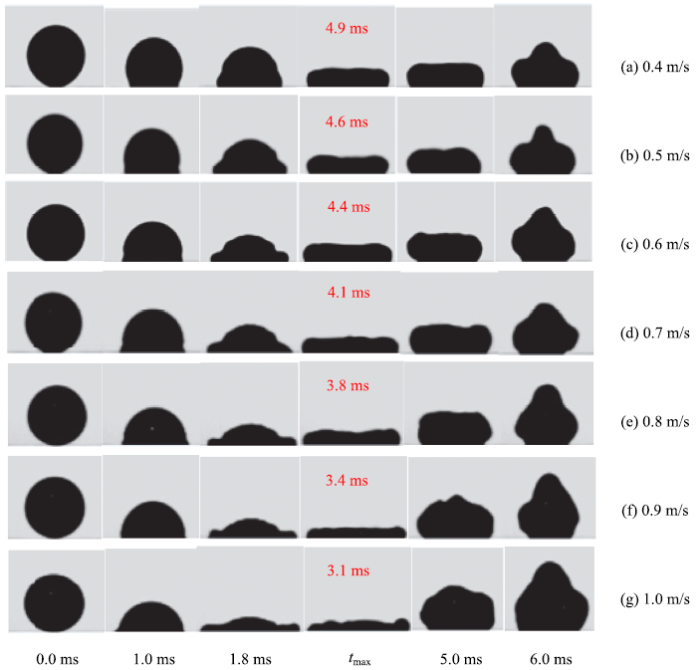
图6
液滴以不同速度撞击无量纲孔径为0.092底板的典型铺展和回缩过程图
Fig.6
Snapshots of droplet contours during the spreading and recoiling processes on foam plate with constant non-dimensional pore size of 0.092 at different impact velocities
为进一步说明撞击速度对于液滴铺展的影响,对图6中液滴与壁面的铺展特性进行了定量的处理,得到了铺展系数随时间的变化结果(如图7(a)).可以看出在早期铺展阶段液滴的铺展不受撞击速度的影响仍然满足$\beta \sim \sqrt {t^\ast }$,而后速度对于铺展的影响开始显现,铺展过程出现差异.液滴以不同的速度撞击底板,撞击速度越大,液滴接触固壁时的动能越大,铺展过程克服阻力后达到的最大铺展系数越大,对应达到最大铺展系数耗费的时间减少.另外,铺展系数的变化结果也表明虽然液滴在铺展阶段铺展速度存在差异,但铺展半径的变化趋势整体一致,铺展受壁面结构影响较小,且铺展系数变化都为光滑的曲线.液滴达到最大铺展半径后开始回缩,受底板结构的影响,液滴表面产生了波动,铺展系数的变化也有所起伏.分析液滴相对中心高度随时间变化结果如图7(b),撞击速度越大液滴铺展时的最小厚度越小,达到最小厚度的时间越短,这与最大铺展半径的变化趋势一致.且在回缩阶段,液滴相对中心轮廓高度随着撞击速度的增大而增大.
图7

图7
液滴以不同速度撞击固定泡沫金属底板(无量纲孔径为0.092)时的铺展系数(a)和轮廓高度(b)随时间变化图
Fig.7
The changes of spreading factor (a) and height of contours (b) with time after droplets impacting with different impacting velocity on a foam metal plate with non-dimensional pore size of 0.092
2.3 GaInSn液滴撞击固壁后的回弹振动特性
由于GaInSn液滴对光滑镍板以及泡沫金属的疏水特性,其回缩阶段末期由于动能未被黏性力和底板阻力完全消耗而产生了回弹现象.回弹后的液滴由于初始形态偏离球形,在空中运动过程中受惯性力与表面张力作用产生振动特性.固体壁面的结构特征将直接影响液滴回弹的初始形态,进而影响其在空中的整个振动过程.本节将讨论GaInSn液滴撞击底板后第一次离开壁面到再次接触壁面时间段内,液滴横向宽度尺寸和纵向高度尺寸随时间的变化规律,并分析形状变化时其自由振动的规律.
图8给出了GaInSn液滴以0.6 m/s速度撞击不同底板后回弹过程中的几个典型时刻轮廓图.在回弹阶段当液滴在纵向被拉伸至最长并即将离开固壁时定义为零时刻(0 ms). 从图中可以看出,液滴在不同底板上产生的回弹特性完全不同.在光滑镍板表面撞击后所产生的回弹为较规则的横向、纵向振动现象(如图9(a)所示),液滴离开壁面时在纵向上产生了较大的拉伸,此时对应的液滴具有最大的表面能;在液滴逐渐上升的过程中,表面能逐渐释放并使得液滴在纵向上的尺寸减小,同时横向的尺寸逐渐增大;在液滴的表面能达到最小的状态下,液滴内部动能最大,液滴开始迅速向横向拉伸,直至液滴内部的动能完全转换成表面能.液滴在横向和纵向产生了往复的规则振动现象.而当液滴撞击在较小孔径的泡沫金属表面时,液滴未出现明显渗入固壁的现象,但由于固体表面结构的各向异性使得液滴回弹时表面受力不均匀,进而产生除纵向和横向振动之外的旋转现象(如图9(b)所示,旋转方向具有一定的随机性),此时液滴在振动过程的形状也变得不规则,而且随着底板无量纲孔径的增大,液滴表现出更强的旋转特性.进一步增大泡沫金属表面的无量纲孔径至0.231时,由于液滴在铺展、回缩过程出现了明显渗入底板的现象(如图4(e)),液滴回弹所产生的特征完全不同.如图8(e)所示,液滴回弹的初始时刻不再是长条形,而表现出了不规则的球形,且液滴离开壁面时具有较大的旋转速度,而对应的纵向和横向振动幅度明显减弱.该种振动模态与液滴在较小无量纲孔径泡沫金属板上的回弹振动完全不同,将其定义为振动形态3(见图9(c)).
图8
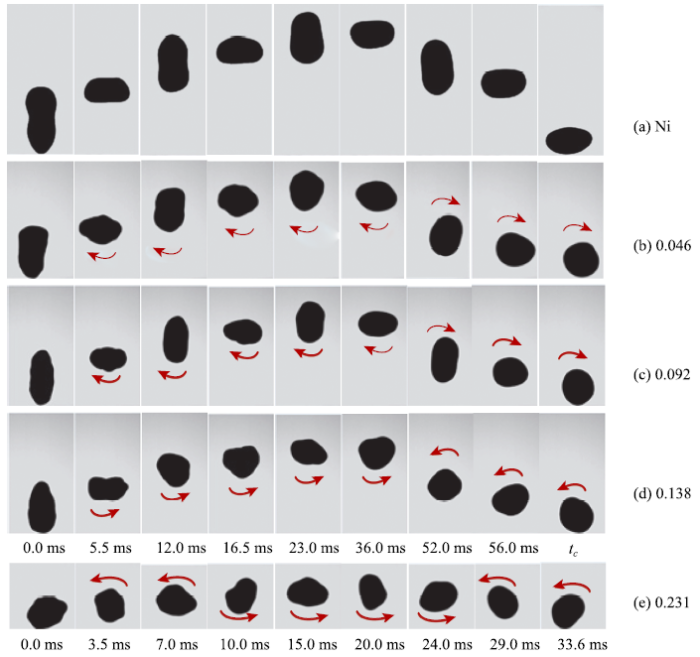
图8
液滴以0.6 m/s速度撞击不同底板上产生的回弹振动典型过程图
Fig.8
Snapshots of droplet contours during rebounding with oscillations on different solid surface with constant impact velocity, 0.6 m/s
图9
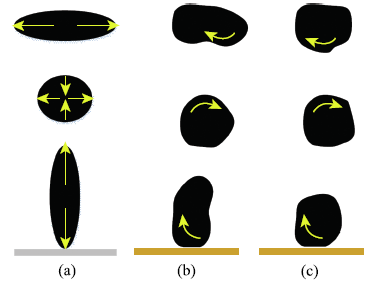
图9
液滴的三种振动形态示意图.
(a)形态1,液滴撞击光滑镍表面后的回弹振动;(b)形态2,液滴撞击小孔径泡沫金属表面的回弹振动;(c)形态3,液滴撞击大孔径泡沫金属表面的回弹振动
Fig.9
Sketch of three modes shape oscillation of the droplet.
(a) Mode 1, droplet rebounds from the nickel; (b) Mode 2, droplet rebounds from the metal foam with small pore sizes; (c) Mode 3, droplet rebounds from the metal foam with large pore sizes
图10
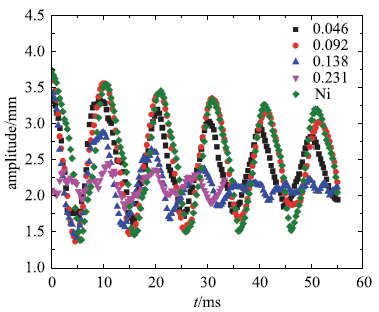
图10
液滴以0.6 m/s的速度撞击不同固壁回弹后的纵向尺度振动特性
Fig.10
The oscillation of droplet after rebounding from different solid plates with constant impact velocity, 0.6 m/s
在液滴振动频率方面,目前已有一些关于液滴或气泡的形状振动理论,Lamb[20]对处于环境介质中的液滴振动问题给出了广义的线性解,认为液滴每个瞬态变形都对应一个独立的自然振动模态,其表达式为
其中,$P_{l}(\cos\theta)$为勒让德多项式,$r_0$为未经扰动的液滴初始半径,$a_l$为$l$阶模态振动的瞬态振幅,$\theta$为以液滴圆心为球坐标原点的极角.由方程(1)可以得到$l$阶振动模态液滴在真空或气体环境中的理论振动角频率
其中,$\sigma$为液滴的表面张力,$l$为液滴的振动模态,$\rho$为液滴的密度.
通过对回弹现象对应的实验工况中液滴的纵向振动幅值随时间变化的结果进行快速傅里叶变换(FFT),我们获得了不同工况下GaInSn液滴回弹振动频率,统计结果如图11所示.从图中可以看出,虽然不同无量纲孔径对应的振动形态不同,其对应的振动频率相差较小,平均值为100.172 Hz(标准差为3.436 Hz).然而这一计算结果与理论结果的误差较大,大部分的结果误差大于10%.通过分析,我们认为产生误差的原因主要有:前人研究液滴或气泡的形状振动时,通常用超声波[41]或电信号[40]施加扰动使液滴产生振动,在这种条件下扰动源相对单一,且扰动量也是可控的,液滴或气泡的形状振动幅值较小均为小振幅振动,振动过程中液滴直径变化与未振动时的直径差距不大,可以用未经扰动的初始半径$r_0$直接代入式(2)计算理论振动频率.然而本文研究的金属液滴撞击底板回弹后产生的振动较为复杂,呈现3种不同的振动形态(如图9所示).首先,液滴形状振动的扰动全部来源于与底板的碰撞过程.由于泡沫金属特殊的孔隙结构,碰撞时扰动较为复杂且扰动量也不可控;其次,液滴撞击底板回弹后的形状变化过程虽然与标准二阶振动模态相似,但不规则固体表面扰动的存在使液滴的形状产生了一定畸变,另外液滴旋转也会加大与标准形状的差异;最后,液滴撞击底板回弹后形状变化量较大,超出了小振幅的范畴,继续使用撞击底板前液滴的初始半径$r_0$来计算理论振动频率具有一定的偏差.
图11
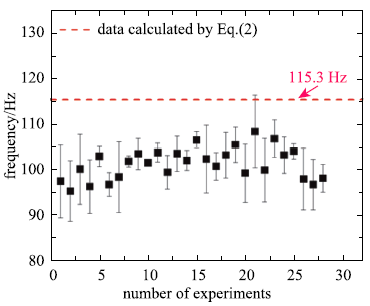
图11
通过FFT计算获得的不同工况下液滴回弹振动的振动频率值,其中虚线为采用式(2)计算获得的理论频率值
Fig.11
The oscillation frequencies of droplet after rebounding under different condition got by the FFT method, while the dash line represents the calculated frequency by Eq. (2)
以上讨论的3种引起误差的因素中,第一和第二点是由于实验过程本身会产生的现象,而如果能够获取更加合理的液滴直径来代替撞击底板前液滴的直径将会提高理论计算的准确性.以液滴本身为参考系,振动过程液滴振幅始终在某个平衡位置作上下波动,这个位置为液滴的振动平衡位置,可以用此位置即振动过程中液滴的平衡直径($d_{0})$来计算理论振动频率.由于液滴内部黏性力的存在,液滴在自由振动时其振幅随时间的变化呈现为衰减的趋势,这里采用衰减振动公式[42]对液滴尺寸变化过程进行拟合,公式为
式中,M为衰减系数($m>0$),A为系数,w为角频率,$\phi$为初始相位,$d_{0}$为振动平衡位置也是振动过程中液滴的平衡直径.
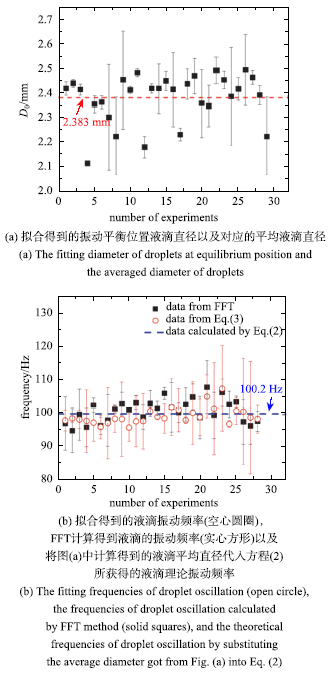
液滴撞击底板回弹后形状变化的振幅很大,并且撞击时底板的扰动使液滴产生了一定的旋转现象,因此振动时液滴的形状与撞击前液滴的形状差别较大.由衰减振动公式我们拟合了前文提到的不同工况下的实验结果,统计结果如图12所示.图12(a)为衰减振动公式拟合得到的液滴振动平衡位置的直径,虚线为拟合直径的平均值(2.383 mm),结果表明液滴平衡位置直径略大于振动前液滴的初始直径(2.167 mm).图12(b)给出了衰减振动公式拟合得到的液滴振动频率(空心圆圈),这一结果与FFT得到的振动频率(实心方形)符合较好.另外,将图12(a)中的拟合平均直径代入式(2)得到对应的理论振动频率(图12(b)虚线,为100.2 Hz,其值小于使用未经扰动液滴尺寸得到的理论振动频率值)与FFT计算结果以及衰减振动公式拟合得到的结果均吻合较好.其中FFT拟合得到的频率结果与修正直径后得到的理论频率相比误差均小于8%,且大部分工况(85.71%的工况)误差在5%以内.而采用衰减振动公式拟合得到的振动频率与修正直径后得到的理论频率相比最大误差为7.7%,其中有92.86%的工况计算结果误差在5%以内.因此,研究GaInSn液滴撞击回弹后的形状振动时,由于液滴的振动变形较大,且同时存在旋转,采用拟合获得的振动平衡位置液滴尺寸进行理论计算能得到与实验结果更为吻合的理论频率值.这也进一步拓展了小振幅的理论频率计算公式(式(2))的适用范围.
图12
3 结 论
本文研究了常温液态镓铟锡合金液滴撞击泡沫金属底板所产生一系列现象,通过对高速相机拍摄到的实验图像进行处理,获得了铺展系数、液滴轮廓相对中心高度以及液滴在空中的振动随时间的变化结果,并通过进一步分析得到以下结论:
(1)具有高表面张力的液态金属撞击不同孔径泡沫金属底板的初始铺展阶段仍符合铺展系数随无量纲时间变化的1/2次幂关系,而在铺展后期表现为液滴在较小的无量纲孔径(0.046,0.092,0.138)底板上的铺展优于在光滑镍板上的铺展,在较大无量纲孔径(0.231)底板上,由于液滴渗入底板,而产生完全不同的铺展现象.
(2)在回缩阶段,液滴的轮廓形态受底板结构的影响较大,即使在较小无量纲孔径的底板(0.046)上,液滴的回缩也呈现出非对称的特性;在较大无量纲孔径底板(0.231)出现了由于铺展阶段的渗入而引起的液滴投影截面积明显变小,液滴相对中心位置轮廓高度减小的现象.
(3)液滴在离开壁面进入回弹阶段时,由于回弹初始形状受底板孔隙结构的影响而使得液滴在振动过程中产生3种不同的振动形态.即规则的横向和纵向振动、带旋转的横向和纵向振动以及旋转振动.
(4)使用衰减振动公式拟合液滴的振动过程,得到振动时平衡位置液滴的直径,用此直径计算形状振动的理论频率值与实验频率值二者符合的很好.与使用撞击前液滴初始直径得到的理论频率相比,大幅提升理论值与实验结果的吻合度,拓展了小振幅的理论频率计算公式(式(2))的适用范围.
参考文献
液滴撞击固体表面铺展特性的实验研究

利用高速摄影仪记录了不同液滴撞击固体表面的形态变化过程,并探讨了液滴撞击参数对撞击过程液滴形态的影响.结果表明:液滴黏度对液滴铺展过程起着决定性作用,液滴表面张力对液滴铺展后的回缩起到主导作用,两者的共同作用决定着液滴的震荡特性;撞击速度的提高会增大液滴的最大铺展因子,但达到最大铺展的时间因表面张力的不同呈现不同变化规律.
Experimental study of spread characteristics of droplet impacting solid surface
利用高速摄影仪记录了不同液滴撞击固体表面的形态变化过程,并探讨了液滴撞击参数对撞击过程液滴形态的影响.结果表明:液滴黏度对液滴铺展过程起着决定性作用,液滴表面张力对液滴铺展后的回缩起到主导作用,两者的共同作用决定着液滴的震荡特性;撞击速度的提高会增大液滴的最大铺展因子,但达到最大铺展的时间因表面张力的不同呈现不同变化规律.
基于SPH方法的液滴撞击可湿润固壁模拟
.液滴撞击固体壁面是一种常见的自然现象和工业过程,在这些现象和过程中液滴运动往往受到壁面可湿润性的影响.本文提出了一种可湿润性固壁边界条件的计算方法,即假设壁面粒子的亲水性以及毛细吸附作用统一表现为对支持域内流体粒子的吸附力.吸附力的大小与流体压强、材料饱和度及亲水性有关.基于光滑粒子流体动力学(SPH)方法,模拟了静态液滴在不同可湿润性壁面上由变形至稳定的过程.考虑壁面可湿润性的影响,模拟了液滴撞击疏水壁面的过程.结合试验数据,分析了壁面可湿润性对液滴运动过程的影响.研究表明:根据模拟液滴静态接触角的变化特点,本文可湿润性固壁边界条件可以较好地反映出壁面可湿润性;液滴撞击输水表面的模拟数据与试验结果趋势上吻合良好,液滴回弹时在壁面可湿润性的影响下形成液柱;壁面可湿润性对撞击后液滴的铺展过程影响很小,在该阶段壁面摩擦力起主要作用,回缩和回弹阶段壁面可湿润性对液滴运动特征的影响较明显.
Numerical studies on droplet impact to wettable solid boundary based on SPH method
液滴撞击固体壁面是一种常见的自然现象和工业过程,在这些现象和过程中液滴运动往往受到壁面可湿润性的影响.本文提出了一种可湿润性固壁边界条件的计算方法,即假设壁面粒子的亲水性以及毛细吸附作用统一表现为对支持域内流体粒子的吸附力.吸附力的大小与流体压强、材料饱和度及亲水性有关.基于光滑粒子流体动力学(SPH)方法,模拟了静态液滴在不同可湿润性壁面上由变形至稳定的过程.考虑壁面可湿润性的影响,模拟了液滴撞击疏水壁面的过程.结合试验数据,分析了壁面可湿润性对液滴运动过程的影响.研究表明:根据模拟液滴静态接触角的变化特点,本文可湿润性固壁边界条件可以较好地反映出壁面可湿润性;液滴撞击输水表面的模拟数据与试验结果趋势上吻合良好,液滴回弹时在壁面可湿润性的影响下形成液柱;壁面可湿润性对撞击后液滴的铺展过程影响很小,在该阶段壁面摩擦力起主要作用,回缩和回弹阶段壁面可湿润性对液滴运动特征的影响较明显.
固体表面液滴铺展与润湿接触线的移动分析
液滴在固体表面上的铺展行为与润湿特性对许多工业生产过程的研究具有重要意义.根据液滴在光滑表面上的受力情况,建立了液滴平壁铺展的动力学模型.应用润滑近似方法和二维Navier-Stokes方程,建立了液滴沿理想表面铺展的动量和连续性方程.根据建立的方程,应用数值解法求解并详细分析了液滴在铺展过程中膜厚、接触线铺展半径以及铺展速度随时间的变化关系.研究结果表明:液滴的铺展过程可分为扩展和收缩两个阶段,铺展过程伴随着表面能、动能以及各种势能的相互转化,液滴最终的铺展半径大小由固体基面固有的润湿特性所决定;液滴在铺展过程中出现的"坍塌效应"与弯曲液面处的Laplace压力差有关;铺展半径随时间变化的标定律近似满足"1/7"次方标度律.
Analyses of droplet spreading and the movement of wetting line on a solid surface
液滴在固体表面上的铺展行为与润湿特性对许多工业生产过程的研究具有重要意义.根据液滴在光滑表面上的受力情况,建立了液滴平壁铺展的动力学模型.应用润滑近似方法和二维Navier-Stokes方程,建立了液滴沿理想表面铺展的动量和连续性方程.根据建立的方程,应用数值解法求解并详细分析了液滴在铺展过程中膜厚、接触线铺展半径以及铺展速度随时间的变化关系.研究结果表明:液滴的铺展过程可分为扩展和收缩两个阶段,铺展过程伴随着表面能、动能以及各种势能的相互转化,液滴最终的铺展半径大小由固体基面固有的润湿特性所决定;液滴在铺展过程中出现的"坍塌效应"与弯曲液面处的Laplace压力差有关;铺展半径随时间变化的标定律近似满足"1/7"次方标度律.
平壁液滴静态铺展影响因素的研究
<p>通过建立液滴撞击固体平壁的静态铺展力学平衡的数学模型,从理论上得到了静态铺展半径与液滴物性参数、以及液滴与固体壁面接触角之间关系的数学表达式,将理论结果与数值模拟的结果进行了比较,两者吻合较好.比较了不同条件下液滴的静态铺展半径的变化规律,分别得到了液滴密度、体积、表面张力和接触角等因素对液滴静态铺展半径的影响规律.</p>
Static spreading of droplet impact on solid surface: Influence factor
<p>通过建立液滴撞击固体平壁的静态铺展力学平衡的数学模型,从理论上得到了静态铺展半径与液滴物性参数、以及液滴与固体壁面接触角之间关系的数学表达式,将理论结果与数值模拟的结果进行了比较,两者吻合较好.比较了不同条件下液滴的静态铺展半径的变化规律,分别得到了液滴密度、体积、表面张力和接触角等因素对液滴静态铺展半径的影响规律.</p>
Drop collisions with simple and complex surfaces
Drop impact onto surfaces has long been a popular and important subject of experimental, numerical and theoretical studies to explain phenomena observed both in nature and in many engineering applications. Progress in understanding and describing the hydrodynamics involved in drop impacts has been rapid in recent years, due partly to the availability of high-speed cameras, but also because of accompanying advances in theoretical and numerical approaches. Thus, for simple surfaces, i.e. smooth surfaces of uniform chemistry, the outcome of a drop impact can be well predicted over a large range of impact parameters, including quantitative values of spread dynamics and splash characteristics. This article comprehensively reviews the present level of understanding for such impact situations.However many practical applications involve impacts onto surfaces of higher complexity, either morphologically or chemically, involving textured or porous surfaces or surfaces with non-uniform wettability characteristics. This expands greatly the parameter space for which descriptions of the impact must be found and the present understanding is significantly more rudimentary compared to drop impacts onto simple surfaces. In this review such impacts are discussed by considering effects introduced by morphological changes to the surface and by changes of the wettability. Comparisons to corresponding impacts onto simple surfaces are drawn to underline the additional physical mechanisms that must be considered.Graphical abstractDrop impact is a fascinating and intricate phenomenon, which is even more difficult if it happens onto complex surfaces. Year 2009: more than 600 papers have been dedicated to this topic. The present paper is trying to individuate some conclusions, addressing the most important results and forecasting future research directions.
Droplet impingement and breakup on a dry surface
In this work, new results of droplet impingement and breakup have been obtained using three-dimensional lattice Boltzmann method. All four phases after impingement, the kinematic, spreading, relaxation and equilibrium phases, leading to breakup have been obtained for a range of Weber number, Reynolds number and density ratio. Conditions have been chosen such that Re We for comparison with available data in the literature. The maximum spread factor compares well with experiments as well as the theoretical value of 0.5 Re 0.25. At Oh < 0.15 and Capillary number, Ca < 1.0, the relaxation phase is marked by the presence of strong oscillations in the spreading diameter. An analytical solution for breakup based on the conservation of energy is provided. Criteria for three-dimensional droplet breakup have been developed as functions of Re and We.
液滴撞击湿润壁面的运动形态及飞溅运动机制
<p>壁面液体层的存在对液滴撞击壁面的运动具有重要的影响。采用气液两相流动相界面追踪的水平集和流体体积复合方法和壁面润湿模型,实现了液滴撞击湿润壁面运动的数值求解;在此基础上,开展了液滴撞击湿润壁面运动的研究。研究结果表明:液滴以不同速度撞击湿润壁面时,会呈现出黏附铺展、波动运动、皇冠几何体运动以及飞溅运动等几种不同的运动形态,液滴撞击湿润壁面后的压力分布是不同运动形态形成的主要原因;飞溅运动是一定条件下皇冠几何体运动的一种特殊形态,液滴从皇冠几何体侧壁顶端的飞溅分离满足毛细破碎理论;撞击速度对分离液滴的运动方向影响较小,而对壁面液体层厚度的影响则较大;撞击速度和壁面液体层厚度对分离液滴形态、飞溅分离位置、飞溅速度以及飞溅发生时刻等都具有一定的影响。</p>
Movement and splashing of a droplet impacting on a wet wall
<p>壁面液体层的存在对液滴撞击壁面的运动具有重要的影响。采用气液两相流动相界面追踪的水平集和流体体积复合方法和壁面润湿模型,实现了液滴撞击湿润壁面运动的数值求解;在此基础上,开展了液滴撞击湿润壁面运动的研究。研究结果表明:液滴以不同速度撞击湿润壁面时,会呈现出黏附铺展、波动运动、皇冠几何体运动以及飞溅运动等几种不同的运动形态,液滴撞击湿润壁面后的压力分布是不同运动形态形成的主要原因;飞溅运动是一定条件下皇冠几何体运动的一种特殊形态,液滴从皇冠几何体侧壁顶端的飞溅分离满足毛细破碎理论;撞击速度对分离液滴的运动方向影响较小,而对壁面液体层厚度的影响则较大;撞击速度和壁面液体层厚度对分离液滴形态、飞溅分离位置、飞溅速度以及飞溅发生时刻等都具有一定的影响。</p>
Drop impact on a solid surface
A drop hitting a solid surface, can deposit, bounce or splash. Splashing arises from the breakup of a fine liquid sheet which is ejected radially along the substrate. Bouncing and deposition depend crucially on the wetting properties of the substrate. In this review we focus on recent experimental and theoretical studies, which aim at unraveling the underlying physics, characterized by the delicate interplay of not only liquid inertia, viscosity and surface tension, but also the surrounding gas. The gas cushions the initial contact, it is entrapped into a central microbubble on the substrate and it promotes the so-called corona-splash, by lifting the lamella away from the solid. Particular attention is paid to the influence of surface roughness, natural or engineered to enhance repellency, relevant in many applications. 1 Figure 1 (a) Worthington's drop-release setup and (b) his sketches of an impacting mercury drop. (c) Using modern video technology for mercury on glass under similar impact conditions. (d) Prompt splash for mercury drop impacting superhydrophobized glass and (e) corona splash for ethanol drop on glass (courtesy of Erqiang Li). See also supplemental video clips.
Dynamics of high-speed micro-drop impact: Numerical simulations and experiments at frame-to-frame times below 100 ns
Technologies including (3D-) (bio-)printing, diesel engines, laser-induced forward transfer, and spray cleaning require optimization and therefore understanding of micrometer-sized droplets impacting at velocities beyond 10 m s 1. However, as yet, this regime has hardly been addressed. Here we present the first time-resolved experimental investigation of microdroplet impact at velocities up toV0= 50 m s 1, on hydrophilic and -phobic surfaces at frame rates exceeding 107frames per second. A novel method to determine the 3D-droplet profile at sub-micron resolution at the same frame rates is presented, using the fringe pattern observed from a bottom view. A numerical model, which is validated by the side- and bottom-view measurements, is employed to study the viscous boundary layer inside the droplet and the development of the rim. The spreading dynamics, the maximal spreading diameter, the boundary layer thickness, the rim formation, and the air bubble entrainment are compared to theory and previous experiments. In general, the impact dynamics are equal to millimeter-sized droplet impact for equal Reynolds-, Weber- and Stokes numbers (Re, We, and St, respectively). Using our numerical model, effective scaling laws for the progression of the boundary layer thickness and the rim diameter are provided. The dimensionless boundary layer thickness develops in time (t) according to, and the diameter of the rim develops as, with drop diameterD0and inertial time scale =D0/V0. These scalings differ from previously assumed, but never validated, values. Finally, no splash is observed, at variance with many predictions but in agreement with models including the influence of the surrounding gas. This confirms that the ambient gas properties are key ingredients for splash threshold predictions.
Retraction dynamics of aqueous drops upon impact on non-wetting surfaces
We study the impact and subsequent retraction dynamics of liquid droplets upon high-speed impact on hydrophobic surfaces. Performing extensive experiments, we show that the drop retraction rate is a material constant and does not depend on the impact velocity. We show that when increasing the Ohnesorge number, $\Oh=\eta/\sqrt{\rho R_{\rm I} \gamma}$, the retraction, i.e. dewetting, dynamics crosses over from a capillaro-inertial regime to a capillaro-viscous regime. We rationalize the experimental observations by a simple but robust semi-quantitative model for the solid-liquid contact line dynamics inspired by the standard theories for thin film dewetting.
Mathematical modeling of the isothermal impingement of liquid droplets in spraying processes
A mathematical representation has been developed and computed results are presented describing the spreading of droplets impacting onto a solid substrate. Problems of this type are of major practical interest in plasma spraying (PS) and in spray forming (SF) operations. While the present study was confined to the fluid flow aspects of the process, information has been generated on both the final splat dimensions and on the time required to complete the spreading process. Through this treatment, it is possible to relate these quantities (the splat size and the spreading time) to the operating conditions, i.e. , droplet size and droplet velocity, and material properties. The theoretical predictions were found to be in good agreement with both Madejski asymptotic solution [17] and with available experimental results. For typical SF conditions (droplet sizes in the 100-碌m range and droplet velocities in the 100 m/s range), the spreading times were of the order of microseconds, i.e. , significantly shorter than the estimated solidification time.
Splat-quench solidification: estimating the maximum spreading of a droplet impacting a solid surface
Drop dynamics after impact on a solid wall: Theory and simulations
We study the impact of a fluid drop onto a planar solid surface at high speed so that at impact, kinetic energy dominates over surface energy and inertia dominates over viscous effects. As the drop spreads, it deforms into a thin film, whose thickness is limited by the growth of a viscous boundary layer near the solid wall. Owing to surface tension, the edge of the film retracts relative to the flow in the film and fluid collects into a toroidal rim bounding the film. Using mass and momentum conservation, we construct a model for the radius of the deposit as a function of time. At each stage, we perform detailed comparisons between theory and numerical simulations of the Navier tokes equation.
Maximal deformation of an impacting drop
We first study the impact of a liquid drop of low viscosity on a super-hydrophobic surface. Denoting the drop size and speed as D_{0} and U_{0}, we find that the maximal spreading D_{scriptsizemax} scales as D_{0}We(1/4) where We is the Weber number associated with the shock (We {equiv} rho U_{0}(2) D_{0}/sigma, where rho and sigma are the liquid density and surface tension). This law is also observed to hold on partially wettable surfaces, provided that liquids of low viscosity (such as water) are used. The law is interpreted as resulting from the effective acceleration experienced by the drop during its impact. Viscous drops are also analysed, allowing us to propose a criterion for predicting if the spreading is limited by capillarity, or by viscosity.
Microscopic structure influencing macroscopic splash at high Weber number
The dynamics of water drop impact at high impinging velocity onto superhydrophobic substrates is experimentally investigated. The solid substrate—comprised of regular and hydrophobic micropillars—is transparent, thereby facilitating close-up, top-or-bottom-view, high-speed imaging. With a sufficient impact velocity, instead of a completely-bouncing “Fakir” droplet, wetting splashing can occur, with an entrapped air bubble at the centre surrounded by a wetted area as well as an emission of satellite droplets during the advancing phase of spreading lamella. A large portion of the lamella travels upon air and subsequently recoils due to surface tension, forming a partial rebound on the central wet spot. We present and discuss quantitative results of the entrapped air bubble, the central wetted area, and the maximal spreading lamella as the impact velocity is increased. We further vary the lattice periodicity of the micro-patterns and find its profound influence on the macroscopic flow. More specifically, directional splashing can emerge, emitting secondary droplets in certain directions which are associated with the lattice. Directional splashing can be suppressed to a gentle spreading by decreasing the periodicity of the lattice and, furthermore, can be tuned to a completely-wetting splashing in the diagonal directions of the lattice by a larger periodicity, offering opportunities to control the wetting process. Finally, the elimination of directional splashing by reducing air pressure suggests that the underlying air is squeezed outwards by the falling droplet upon the solid boundary whereby the air flow is affected, leading to different splashing behavior.
Capillary effects during droplet impact on a solid surface
Impact of water droplets on a flat, solid surface was studied using both experiments and numerical simulation. Liquid-solid contact angle was varied in experiments by adding traces of a surfactant to water. Impacting droplets were photographed and liquid-solid contact diameters and contact angles were measured from photographs. A numerical solution of the Navier-Stokes equation using a modified SOLA-VOF method was used to model droplet deformation. Measured values of dynamic contact angles were used as a boundary condition for the numerical model. Impacting droplets spread on the surface until liquid surface tension and viscosity overcame inertial forces, after which they recoiled off the surface. Adding a surfactant did not affect droplet shape during the initial stages of impact, but did increase maximum spread diameter and reduce recoil height. Comparison of computer generated images of impacting droplets with photographs showed that the numerical model modeled droplet shape evolution correctly. Accurate predictions were obtained for droplet contact diameter during spreading and at equilibrium. The model overpredicted droplet contact diameters during recoil. Assuming that dynamic surface tension of surfactant solutions is constant, equaling that of pure water, gave predicted droplet shapes that best agreed with experimental observations. When the contact angle was assumed constant in the model, equal to the measured equilibrium value, predictions were less accurate. A simple analytical model was developed to predict maximum droplet diameter after impact. Model predictions agreed well with experimental measurements reported in the literature. Capillary effects were shown to be negligible during droplet impact when We much greater than Rel(1/2). (C) 1996 American Institute of Physics.
Analytical consideration of liquid droplet impingement on solid surfaces
In industrial applications involving spray-cooling, combustion, and so on, prediction of the maximum spreading diameter of a droplet impinging on a solid surface permits a quantitative estimation of heat removal and energy consumption. However, although there are many experimental studies regarding droplet impingement behaviour, theoretical models have an applicability limit for predicting the maximum spreading diameter. In the present study, we have developed an analytical model for droplet impingement based on energy conservation that considers adhesion energy in both horizontal and vertical directions at the contact line. The theory is validated by our experiment and existing experimental data possessing a wide range of Weber numbers. We demonstrate that our model can predict尾m(i.e., the maximum spreading diameter normalised in terms of initial droplet diameter) for various Newtonian liquids ranging from micro- to millimetre-sized droplets on different solid surfaces and can determine the transition between capillary and viscous regimes. Furthermore, theoretical relations for scaling laws observed by many researchers are derived.
Spread and rebound of liquid droplets upon impact on flat surfaces
Abstract The spread and rebound of droplets upon impact on flat surfaces at room temperature were studied over a wide range of impact velocities (0.5–6 m/s), viscosities (1–100 mPa.s), static contact angles (30–120°), droplet sizes (1.5–3.5 mm), and surface roughnesses using a fast-shutter-speed CCD camera. The maximum spread of a droplet upon impact depended strongly on the liquid viscosity and the impact velocity. The tendency of a droplet to deposit or to rebound is determined primarily by the liquid viscosity and the liquid/substrate static contact angle. A model more broadly applicable than existing models was developed to predict maximum spread as a function of the Reynolds number, the Weber number, and the static contact angle. Based on the conservation of energy, a rebound model is proposed that predicts the tendency to rebound as a function of maximum spread and static contact angle. The maximum-spread model prediction agrees to within 10% with more than 90% of the experimental data from different sources. In the current study, the rebound model successfully predicts the tendency of a droplet to rebound.
Experimental and theoretical investigation of large-amplitude oscillations of liquid droplets
Finite-amplitude, axially symmetric oscillations of small (0.2 mm) liquid droplets in a gaseous environment are studied, both experimentally and theoretically. When the amplitude of natural oscillations of the fundamental mode exceeds approximately 10% of the droplet radius, typical nonlinear effects like the dependence of the oscillation frequency on the amplitude, the asymmetry of the oscillation amplitude, and the interaction between modes are observed. As the amplitude decreases due to viscous damping, the oscillation frequency and the amplitude decay factor reach their asymptotical values predicted by linear theory. The initial behaviour of the droplet is described quite satisfactorily by a proposed nonlinear inviscid theoretical model.
Shape oscillations of particle-coated bubbles and directional particle expulsion
Bubbles stabilised by colloidal particles can find applications in advanced materials, catalysis and drug delivery. For applications in controlled release, it is desirable to remove the particles from the interface in a programmable fashion. We have previously shown that ultrasound waves excite volumetric os Soft Matter Emerging Investigators 2017
Shape oscillations on bubbles rising in clean and in tap water
This paper deals with air bubbles rising in purified water in the range of equivalent diameters where surface oscillations appear on the interface. The shape of the bubbles including these capillary distortions is recorded by taking a large number of high speed pictures for each spiraling or zigzagging bubble trajectory. In analogy with surface harmonics, the oscillations are indicated as (2,0) axisymmetric and with wavelength equal to the distance from pole to pole and (2,2) nonaxisymmetric and with wavelength equal to one-half of the length of the equator. In the second series of experiments, the phenomena in the wakes of rising bubbles are made visible by using Schlieren optics, which are applicable because a temperature gradient is applied to the water. The frequencies of vortex shedding correspond to the (2,0) mode of surface oscillation, whereas in other works reported in the literature, they correspond to twice the frequency of the spiraling or zigzagging bubble paths. By measurements and by analysis, it is shown here that the latter is due to contamination of surfactants.
Shape oscillation of microbubbles
Microbubbles – gas bubbles of diameter less than 1mm – became currently of considerable importance for chemical and process engineering applications, mainly because of the recent discovery of an energetically efficient method of their generation with a fluidic oscillator in the gas supply into an aerator. The oscillation should be applied at the microbubble resonant conditions, about which there has been so far known very little. The key problem is the unknown and difficult to evaluate extent of the surrounding liquid that takes part in the microbubble oscillatory motions and represents the inertia term in the governing equation. The oscillation of microbubbles also influences their ascent, which is slow and puts them often into mutual proximity causing their conjunctions. Author evaluated basic data on oscillating microbubbles from high-speed camera frames and used them to setup a simple model, suitable for engineering design purposes.
Effect of rising motion on the damped shape oscillations of drops and bubbles
The objective of this work is to determine the effect of the rising motion on the dynamics of inertial shape oscillations of drops and bubbles. We have carried out axisymmetric direct numerical simulations of an ascending drop (or bubble) using a level-set method. The drop is initially elongated in the vertical direction and therefore performs shape oscillations. The analysis is based on the decomposition of the interface into spherical harmonics, the time evolutions of which are processed to obtain the frequency and the damping rate of the oscillations. As the drop accelerates, its shape flattens and oscillations no longer take place around a spherical equilibrium shape. This causes the eigenmode of oscillations to change, which results in the appearance of spherical harmonics of high order that all oscillate at the same frequency. For both drops and bubbles, the frequency, which remains controlled by the potential flow, slightly decreases with the rising velocity. The damping rate of drops, which is controlled by the dissipation within boundary layers at the interface, strongly increases with the rising velocity. At terminal velocity, the damping rate of bubbles, which results from the dissipation by the potential flow associated with the oscillating motion, remains close to that of a non-rising bubble. During the transient, the rate of deformation of the equilibrium shape of bubbles can be comparable to the oscillation frequency, which causes complex evolutions of the shape. These results extend the description of shape oscillations to common situations where gravity plays a role. In particular, the present conclusions are useful to interpret experimental results where the effect of the rising motion is often combined with that of surfactant.
Capillary oscillations of a constrained liquid drop
An inviscid spherical liquid drop held by surface tension exhibits linear oscillations of a characteristic frequency and mode shape (Rayleigh oscillations). If the drop is pinned on a circle of contact the mode shapes change and the frequencies are shifted. The linear problem of inviscid, axisymmetric, volume-preserving oscillations of a liquid drop constrained by pinning along a latitude is solved here. The formulation gives rise to an integrodifferential boundary value problem, similar to that for Rayleigh oscillations, and for oscillations of a drop in contact with a spherical bowl [M. Strani and F. Sabetta, J. Fluid Mech. 141, 233 (1984)], only more constrained. A spectral method delivers a truncated solution to the eigenvalue problem. A numerical routine has been used to generate the eigenfrequencies/eigenmodes as a function of the location of the pinned circle of constraint. The effect of pinning the drop is to introduce a new low-frequency eigenmode. The center-of-mass motion, important in application, is partitioned among all the eigenmodes but the low-frequency mode is its principal carrier.
Shape oscillation and static deformation of drops and bubbles driven by modulated radiation stresses--Theory
Deformations of drops and bubbles opposed by surface tension and driven by radiation stresses at the interface are calculated using spherical harmonic expansions for the radial and tangential stresses. Superimposed acoustic waves produce stresses which oscillate at the difference frequency ω of the waves in addition to static stresses. When the effects of viscosity on the acoustic waves are omitted, the tangential radiation stress vanishes; a procedure is proposed for calculating the radial stresses from the theory for ’’Acoustic Radiation Pressure on a Compressible Sphere’’ [K. Yosioka and Y. Kawasima, Acustica 5, 167–173 (1955)]. The calculation of the response assumes incompressible second‐order flow and omits the body forces which are normally asociated with acoustic streaming. Resonance phase shifts and enhancements of the response should occur when ω is close to the natural oscillation frequency of a mode. Quadrupole resonance phase shifts and enhancements have been observed by the author [J. Acoust. Soc. Am. 67, 27–37 (1980)]. Diverse applications of the theory include the possibilities of: inference of the interfacial tension from the response; emulsification by exciting large amplitude oscillations; and deformation or splitting of bubbles by radiation stresses. The decay time of free oscillation is also calculated; a new term is found which is small but significant for drops surrounded by a liquid and supplements the theory for ’’The Oscillations of a Fluid Droplet Immersed in Another Fluid’’ [C. A. Miller and L. E. Scriven, J. Fluid Mech. 32, 417–435 (1968)].
Linear oscillations of constrained drops, bubbles, and plane liquid surfaces
The small-amplitude oscillations of constrained drops, bubbles, and plane liquid surfaces are studied theoretically. The constraints have the form of closed lines of zero thickness which prevent the motion of the liquid in the direction normal to the undisturbed free surface. It is shown that, by accounting explicitly for the singular nature of the curvature of the interface and the force exerted by the constraint, methods of analysis very close to the standard ones applicable to the unconstrained case can be followed. Weak viscous effects are accounted for by means of the dissipation function. Graphical and numerical results for the oscillations of constrained drops and bubbles are presented. Examples of two- and three-dimensional gravity-capillary waves are treated by the same method. A brief consideration of the Rayleigh-Taylor unstable configuration shows that the nature of the instability is not affected, although its growth rate is decreased.
Freezing-induced splashing during impact of molten metal droplets with high Weber numbers
The impact of molten tin droplets (0.6 mm diameter) on solid surfaces was observed for a range of impact velocities (10–30 m/s), substrate temperatures (25–200 °C) and substrate materials (stainless steel, aluminum and glass). The substrate was mounted on the rim of a rotating flywheel and the collision of single droplets with the moving substrate was photographed. Droplet impact Reynolds number ranged from 2.2 × 10 4 to 6.5 × 10 4 and Weber number from 8.0 × 10 2 to 7.2 × 10 3. On a hot surface there was no splashing and droplets spread to form disk-like splats with smooth edges. Solidification around the edges of droplets spreading on cold surfaces created a solid rim that obstructed flow and triggered splashing. An analytical model was developed to predict the transition temperature at which splashing disappeared by assuming that the thickness of the solid layer had to equal that of the splat in the time the droplet spread to its maximum extent in order to obstruct liquid flow. The model predicted the transition temperature for aluminum and stainless steel surfaces, assuming that thermal contact resistance between the droplet and substrate varied between 10 616 and 10 617 m 2 K/W. The model also predicted that tin droplets would not splash on glass surfaces maintained at or above room temperature, and this was confirmed by experiments.
Spreading of mercury droplets on thin silver films at room temperature
We study the spreading characteristics of a reactive-wetting system of mercury (Hg) droplets on silver (Ag) films in room temperature. This is done using our recently developed method for reconstructing the dynamical three-dimensional shape of spreading droplets from two-dimensional microscope images [A. Be'er and Y. Lereah, J. Microsc. 208, 148 (2002)]. We study the time evolution of the droplet radius and its contact angle, and find that the spreading process consists of two stages: (i) the "bulk propagation" regime, controlled by chemical reaction on the surface, and (ii) the "fast-flow" regime, which occurs within the metal film as well as on the surface and consists of both reactive and diffusive propagation. We show that the transition time between the two main time regimes depends solely on the thickness of the Ag film. We also discuss the chemical structure of the intermetallic compound formed in this process.
Spreading of a mercury droplet on thin gold films
The spreading of a small mercury droplet (150 μm) on thin gold films is studied, using an optical microscope enhanced with a differential interference contrast system. The growing interfaces are analyzed in order to determine the roughness ( α) and growth ( β) exponents. For gold film thickness of 1500 A 06 we find that α=0.88±0.03 and β=0.76±0.03, while for gold thickness of 3000 A 06, α=0.96±0.04 and β=1.00±0.04. Both sets of exponents satisfy the scaling relation α+ α/ β=2. In both systems the roughness exponent α crosses over to a value close to 0.5 in the final stages of the experiment and for relatively long length scales (order of a few microns).
Elliptical spreading characteristics of a liquid metal droplet impact on a glass surface under a horizontal magnetic field
The spreading characteristics of a liquid GaInSn alloy droplet on a glass surface with the action of a horizontal magnetic field have been experimentally investigated in the present paper. With changing the impact velocity from 0.1 m/s to 1.2 m/s and increasing the magnetic field from 0 T to 1.6 T, we focus on studying the influence of the horizontal magnetic field on the spreading characteristics of a liquid metal droplet using the shadow-graph method. The elliptical spreading pattern of a liquid metal droplet induced by the horizontal magnetic field was discovered by experiments. By introducing a numerical method in getting the distribution of current lines and the Lorentz force inside the droplet, we give a detailed explanation on the mechanism of elliptical spreading. Furthermore, some quantitative results on a maximum spreading factor and time at moment of maximum spreading varied with the Hartmann number and Weber number are shown to give us a comprehensive understanding of the elliptical spreading. With the increasing of the magnetic field, the maximum spreading factor in the front view is reduced while that in the side view is increased, which reveals a larger deformation happened during the spreading process. While with the increasing of impact velocity, the spreading factor increased. Finally, we present a non-dimensional parameter to get scaling laws for the averaged maximum spreading factor and the aspect ratio of the maximum spreading factor; results show that the predict data can agree with experimental data in a certain degree.
Splashing of molten tin droplets on a rough steel surface
We photographed the impact of molten metal droplets on a flat plate. From these images we measured droplet dimensions during spreading and counted the number of fingers around a splashing drop. Experiments were done using stainless steel substrates with average roughness of 0.06, 0.07, 0.56, and 3.45 μm respectively. The temperature of the substrate was kept at either 25 or 240 °C. Droplet diameter (2.2 mm) and impact velocity (4 m/s) were kept constant, giving a Reynolds number ( Re) of 31 135 and Weber number ( We) of 463. Raising substrate roughness from 0.06 to 0.56 μm enhanced the tendency of droplet to splash, whereas increasing roughness even further to 3.45 μm suppressed splashing. This behaviour was attributed to changes in droplet solidification rate with surface roughness. A simple model of droplet spreading was used to estimate thermal contact resistance between the droplet and surface. Increasing surface roughness was found to raise thermal contact resistance and reduce heat transfer from the droplet to the substrate, delaying the onset of solidification and reducing splashing. The number of fingers formed around a droplet splashing on a smooth surface could be predicted reasonably well by a model based on Rayleigh–Taylor instability theory. Increasing surface roughness reduced the number of fingers while enlarging their size.
GaInSn usage in the research laboratory
GaInSn, a eutectic alloy, has been successfully used in the Magneto-Thermofluid Research Laboratory at the University of California-Los Angeles and at the Princeton Plasma Physics Laboratory for the past six years. This paper describes the handling and safety of GaInSn based on the experience gained in these institutions, augmented by observations from other researchers in the liquid metal experimental community. GaInSn is an alloy with benign properties and shows considerable potential in liquid metal experimental research and cooling applications.
Characterization of nontoxic liquid-metal alloy galinstan for applications in microdevices
We have obtained interfacial properties of Galinstan, a nontoxic liquid-metal alloy, to help replace mercury in miniature devices. To prevent formation of an oxide skin that severely hinders the fluidic behavior of small Galinstan droplets and leads to inaccurate property data, we performed our experiments in a nitrogen-filled glove box. It was found that only if never exposed to oxygen levels above 1 part per million (ppm) would Galinstan droplets behave like a liquid. Two key properties were then investigated: contact angles and surface tension. Advancing and receding contact angles of Galinstan were measured from sessile droplets on various materials: for example, 146.8 and 121.5, respectively, on glass. Surface tension was measured by the pendant-drop method to be 534.6 10.7 mN/m. All the measurements were done in nitrogen at 28 with oxygen and moisture levels below 0.5 ppm. To help design droplet-based microfluidic devices, we tested the response of Galinstan to electrowetting-on-dielectric actuation.
Effect of oxidation on the mechanical properties of liquid gallium and eutectic gallium-indium
Liquid metals exhibit remarkable mechanical properties, in particular large surface tension and low viscosity. However, these properties are greatly affected by oxidation when exposed to air. We measure the viscosity, surface tension, and contact angle of gallium and a eutectic gallium-indium alloy while controlling such oxidation by surrounding the metals with an acid bath of variable concentration. Rheometry measurements reveal a yield stress directly attributable to an oxide skin that obscures the intrinsic behavior of the liquid metals. We demonstrate how the intrinsic viscosity can be obtained with precision through a scaling technique that collapses low- and high-Reynolds number data. Measuring surface tension with a pendant drop method, we show that the oxide skin generates a surface stress that mimics surface tension and develop a simple model to relate this to the yield stress obtained from rheometry. We find that yield stress, surface tension, and contact angle all transition from solid-like to liquid behavior at the same critical acid concentration, thereby quantitatively confirming that the wettability of these liquid metals is due to the oxide skin.
Time evolution of liquid drop impact onto solid, dry surfaces
The normal impact of liquid drops onto solid, dry surfaces has been studied experimentally, using high-resolution digital photography. A large number of parameters were varied in a systematic manner. The focus of this paper is the quantitative determination of the influence of these parameters on the drop spreading upon impact and on the phenomenological description of the outcomes. Dimensional similarity of the spreading can only be achieved for the very early stage of the impact process. At later stages, the number of influencing factors increases, generally precluding any universal correlation. Particular emphasis is placed on the influence of the wettability and the surface roughness on spreading.
Splashing of liquids: interplay of surface roughness with surrounding gas
Abstract We investigate the interplay between substrate roughness and surrounding gas pressure in controlling the dynamics of splashing when a liquid drop hits a dry solid surface. We associate two distinct forms of splashing with each of these control parameters: Prompt splashing is due to surface roughness and corona splashing is due to instabilities produced by the surrounding gas. The size distribution of ejected droplets reveals the length scales of the underlying droplet-creation process in both cases.
Droplet impact dynamics for two liquids impinging on anisotropic superhydrophobic surfaces
Droplet impingement experiments were performed on grooved hydrophobic surfaces with cavity fractions of 0, 80, and 93 % using droplets of water and a 50 %/50 % water/glycerol mixture. The influence of liquid viscosity, cavity fraction, and spreading direction, relative to the surface grooves, is explored qualitatively and quantitatively. The maximum droplet spread diameter, velocity of the rebounding jet, and the time delay between droplet impact and jet emission were characterized for Weber numbers, We, based on droplet impact speed and diameter, up to 500. The unequal shear stresses and contact angles influence the maximum spread diameters in the two primary spread directions. At We > 100, the ratio of the spread diameter along the direction of the grooves to the spread diameter perpendicular to the grooves increases above unity with increasing We. The maximum droplet spread diameter is compared to recent predictive models, and the data reveal differing behavior for the two fluids considered. The results also reveal the existence of very high relative jet velocities in the range 5 les We les 15 for water droplets, while such jets were not observed for the more viscous mixture. Further, in the range 115 les We les 265, the water/glycerol jet formation dynamics are radically different from the water behavior. Most evident is the existence of two-pronged jets, which arise from the anisotropy of the surface and the unequal shear stresses and contact angles that prevail on the surfaces. It is these influences that give rise to differences in the maximum spread diameters in the two primary spread directions. Similar two-pronged jet emission was observed for water over the very narrow range of We from 91 to 96. The issuing jet velocities were also observed to increase with increasing cavity fraction for both fluids and over the entire range of We explored. Lastly, the elapsed time between droplet impact and jet emission decreased with increasing cavity fraction.
Nonlinear oscillations of inviscid drops and bubbles
Moderate-amplitude axisymmetric oscillations of incompressible inviscid drops and bubbles are studied using a Poincaré–Lindstedt expansion technique. The corrections to the drop shape and velocity potential caused by mode coupling at second order in amplitude are predicted for two-, three- and four-lobed motions. The frequency of oscillation is found to decrease with the square of the amplitude; this result compares well with experiments and numerical calculations for drops undergoing two-lobed oscillations.
Shape oscillation of a drop in ac electrowetting
A sessile drop oscillates when an ac voltage is applied in electrowetting. The oscillation results from the time-varying electrical force concentrated on the three-phase contact line. Little is known about the feature of drop oscillation in electrowetting. In the present work, the drop oscillations are observed systematically, and a theoretical model is developed to analyze the oscillation. It is revealed that resonance occurs at certain frequencies and the oscillation pattern is significantly dependent on the applied ac frequencies. The domain perturbation method is used to derive the shape-mode equations under the assumptions of a weak viscous effect and small drop deformation. The electrical force concentrated on the three-phase contact line is approximated as a delta function, which is decomposed and substituted into each shape-mode equation as a forcing term. The theoretical results for the shape and frequency responses are compared with experimental results, which shows qualitative agreement.
Microbubble shape oscillations excited through ultrasonic parametric driving
An air bubble driven by ultrasound can become shape-unstable through a parametric instability. We report time-resolved optical observations of shape oscillations (mode n=2 to 6) of micron-sized single air bubbles. The observed mode number n was found to be linearly related to the ambient radius of the bubble. Above the critical driving pressure threshold for shape oscillations, which is minimal at the resonance of the volumetric radial mode, the observed mode number n is independent of the forcing pressure amplitude. The microbubble shape oscillations were also analyzed numerically by introducing a small nonspherical linear perturbation to a Rayleigh-Plesset-type equation, capturing the experimental observations in detail.


