等离子体激励器诱导射流的湍流特性研究
张鑫 , 黄勇
, 黄勇
INVESTIGATION ON THE TURBULENT CHARACTERISTICS OF THE JET INDUCED BY A PLASMA ACTUATOR
Zhang Xin, Huang Yong
中图分类号: V211
文献标识码: A
通讯作者:
版权声明: 2018 力学学报期刊社 力学学报期刊社 所有
基金资助:
展开
摘要
为了进一步掌握等离子体流动控制机理, 完善等离子体激励器数学模型, 提升等离子体激励器扰动能力, 采用粒子图像测速技术, 在静止空气下开展了介质阻挡放电等离子体激励器诱导射流特性研究. 实验时, 将非对称布局激励器布置在平板模型上, 随后将带有激励器的模型放置在有机玻璃箱内, 从而避免环境气流对测试结果的影响. 基于激励器诱导流场, 分析了激励电压对诱导射流特性的影响, 揭示了较高电压下诱导射流近壁区的拟序结构, 获得了卷起涡、二次涡等拟序结构的演化发展过程, 计算了卷起涡脱落频率, 阐述了卷起涡与启动涡的区别, 初步探索了卷起涡的耗散机制. 结果表明: (1)层流射流不能完全概括等离子体诱导射流特性, 激励电压是影响射流特性的重要参数. 当电压较低时, 诱导射流为层流射流; 当电压较高时, 诱导射流的雷诺数提高, 射流剪切层不稳定, 层流射流逐渐发展为湍流射流. (2)等离子体诱导湍流射流包含着卷起涡、二次涡等拟序结构; 在固定电压下, 这些涡结构存在恒定的卷起频率. (3)当激励电压较高时, 流动不稳定使得卷起涡发生了拉伸、变形, 引起了流场湍动能增大, 从而加速了卷起涡的耗散. 研究结果为全面认识激励器射流特性, 进一步挖掘激励器卷吸掺混能力, 提升激励器控制能力积累基础.
关键词:
Abstract
In order to understand the controlling mechanism of plasma actuator and develop the mathematical model of plasma actuator, the turbulent characteristics of the jet induced by a dielectric barrier discharge (DBD) plasma actuator in quiescent air was studied in a closed chamber using particle image velocimetry (PIV). Here, an asymmetrical DBD plasma actuator was mounted on the plate model. First, measured time-averaged velocity field induced by the DBD plasma actuator indicated that voltage amplitude is an important parameter and could affect the flow characteristics of the induced jet. When the plasma actuator was driven at low voltage, the induced jet was a laminar wall jet. On the other hand, the Reynolds number of induced jet was improved and the shear layer was instability when the plasma actuator was actuated at high voltage. Then the induced jet became a turbulent wall jet. Secondly, the results of transient flow field structure suggested that the induced turbulent wall jet had some coherent structures, such as rolling up vortex and secondary vortex in the near-wall region. And these structures were linked to a dominant frequency of
Keywords:
等离子体流动控制技术是典型的主动流动控制技术之一. 该技术因具有结构简单、工作稳定、响应迅速等优点, 近十五年以来是流动控制研究领域的热点, 数十个国家的研究人员开展过该项研究[1-23].
在研究中,介质阻挡放电(dielectric barrier discharge, DBD)等离子体激励器(以下简称激励器)作为该项技术的核心, 其诱导流场特性研究成为该项研究的重点之一. 对于正弦交流电源激励的激励器来说, 一般认为通过激励器诱导射流产生的动量效应是主要的控制机理[24-26]. 自1998年, 美国田纳西州立大学Roth等[27]发现激励器诱导射流效应以来, 已有来自几十个科研院所的研究人员开展过此项研究. 更高的诱导射流速度、更广的诱导流场范围、更强的激励器控制能力, 是研究人员追求的目标. 但研究结果发现[28], 单个激励器的最大诱导射流速度不超过10 m/s. 而常规飞行器的起降、巡航速度多在70 m/s以上. 与来流相比, 由激励器诱导射流提供的动量较小. 然而近年来部分研究结果表明: 采用正弦交流激励的等离子体激励器已在
2007年, 英国诺丁汉大学Jukes等[34]首次对诱导射流特性给予了描述. 他通过将诱导射流速度剖面与典型的层流射流速度剖面进行对比, 指出激励器诱导射流为层流射流. 但该实验的激励电压较低. 因此, 实验结果能否全面描述诱导射流特性还需进一步验证. 本文采用高频粒子图像测速(particle image velocimetry, PIV)技术, 在不同激励电压下, 开展激励器诱导射流特性研究, 分析射流特性与激励电压之间的关系, 研究较高电压下诱导射流近壁区的拟序结构, 为深刻理解等离子体流动控制机理, 全面认识激励器激励特性, 进一步提升激励器控制能力, 提供科学支撑.
1 DBD等离子体基本原理
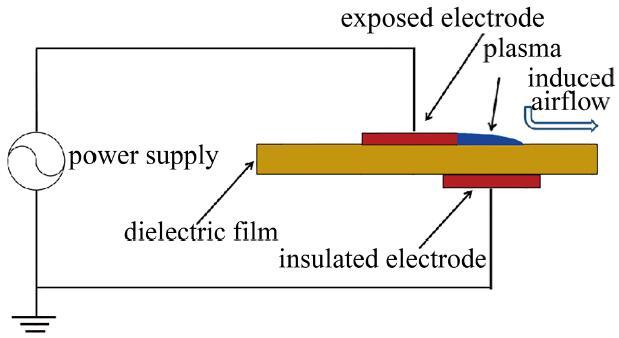
图1给出了典型的激励器布局示意图. 激励器由上、下两层电极、绝缘介质以及激励电源等组成. 两层电极由绝缘介质隔开, 并与激励电源相连. 当交流电压超过一定阈值时, 电极周围的空气发生电离. 由电离产生的带电粒子在电场作用下, 发生定向运动. 在运动过程中, 带电粒子与空气分子发生碰撞, 从而产生射流[35-36].
2 实验系统
实验在静止空气下进行. 采用由德国LaVision公司研制的高速PIV系统开展激励器诱导流场研究. 图2给出了实验设备布局图. 如图2所示, 为了减少环境气流对测量结果的影响, 将激励器及平板模型放置在密封箱体内. 箱体由有机玻璃制成, 其长宽高分别为800 mm

采用由德国生产的Laskin粒子发生器播撒示踪粒子. 示踪粒子为DEHS(Di-ethyl-hexyl-sebacate), 粒径为1 μm. 实验前, 通过烟雾进气口将示踪粒子注入到腔体内. 随后, 通过盖板将烟雾进气口封上. 待粒子分布均匀后, 再开展实验. 数据处理时, 运算窗口大小为16像素
平板模型由有机玻璃制成, 其长宽高分别为240 mm
激励器采用传统非对称布局布置, 并粘贴在平板模型上. 采用宽度5 mm、厚度0.05 mm的铜箔电极作为激励器上、下两层电极. 两层电极的搭接长度为0. 采用4层聚酰亚胺绝缘胶带将两层电极隔开. 该绝缘胶带的单层厚度为0.1 mm. 坐标原点定义在两层电极的搭接处. 实验时, 通过走线孔, 将高压电源的输出端引至激励器, 并分别与上、下两层电极相连.
采用西安浩宁电子科技有限公司生产的多相位交流电源作为激励电源. 该电源的电压峰值范围为0
3 实验结果及分析
3.1 时均流场
图3给出了两种电压下激励器诱导的平均速度场. 其中

图3 静止空气下激励器诱导平均速度场.
Fig.3 Time-averaged velocity field induced by the DBD plasma actuator in quiescent air
图4给出了两种激励电压下, 不同弦向位置的诱导射流无量纲速度剖面. 其中
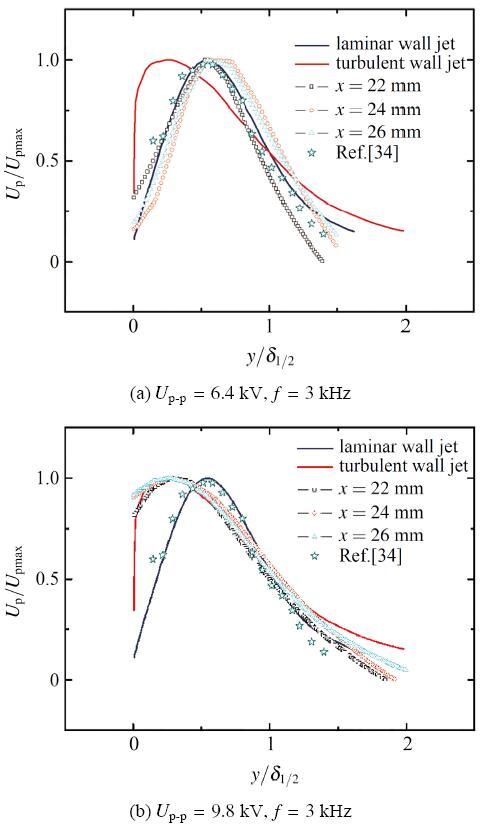
图4 静止空气下激励器诱导射流无量纲速度剖面.
Fig.4 Non-dimensional velocity profiles of the DBD plasma actuator in quiescent air
图5给出了两种电压下, 诱导射流雷诺数随
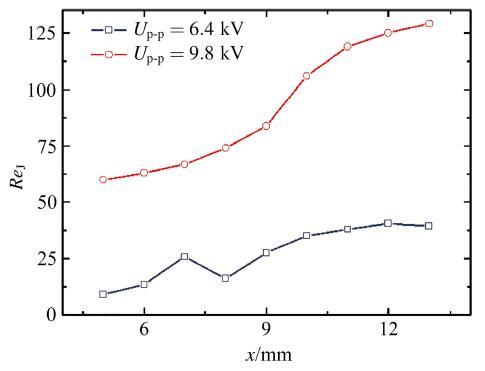
图5 静止空气下激励器诱导射流雷诺数随
Fig.5 Reynolds number of plasma jet over the surface in quiescent air
3.2 瞬时流场
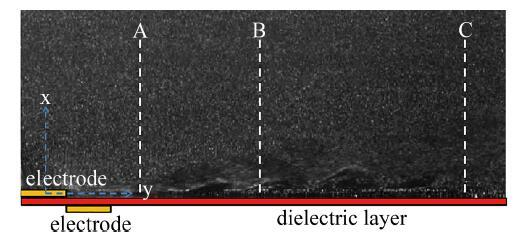
图6给出了相同时刻
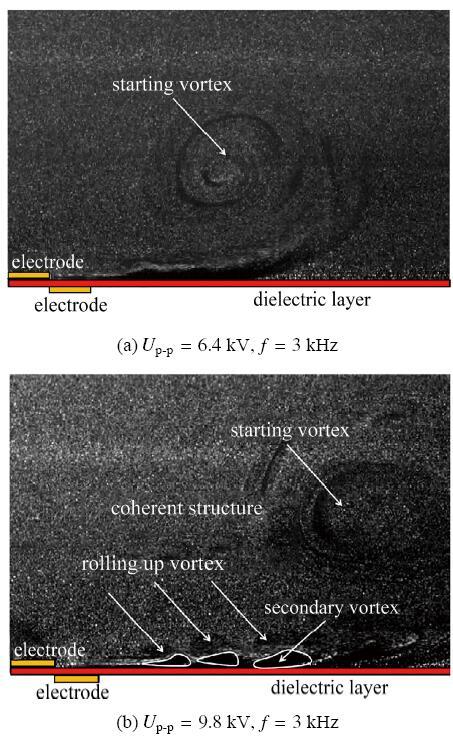
图6 静止空气下激励器诱导流场的PIV原始图.
Fig.6 Original PIV images of the flow field induced by plasma actuator in quiescent air
由瞬态流场结果可知(如图6(b)所示), 卷起涡及二次涡随时间不断向激励器下游发展. 因此, 通过频域分析, 可以获得卷起涡及二次涡的特征频率. 根据射流理论[39], 在起始
将每一个点的法向脉动速度
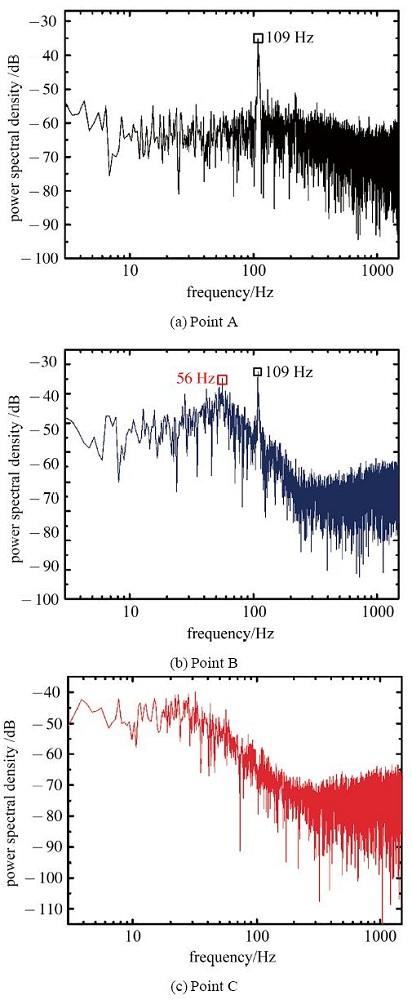
图8 不同位置的法向脉动速度功率谱.
Fig.8 Power spectra of the vertical fluctuating velocity at different locations
依据主频, 获得了卷起涡的运动周期. 图9给出了一个周期内, 旋涡强度分布随时间变化情况. 其中swirl 是速度梯度张量特征值的虚部, 代表旋涡强度. 不少研究人员常采用旋涡强度去探测及分析旋涡, 具体的计算方法请参照文献[40]. 由图9可知, 诱导流场在壁面附近出现了几个旋涡强度较高的离散区域; 其中紧贴壁面的区域代表二次涡, 而二次涡上方的集中区域代表了卷起涡.
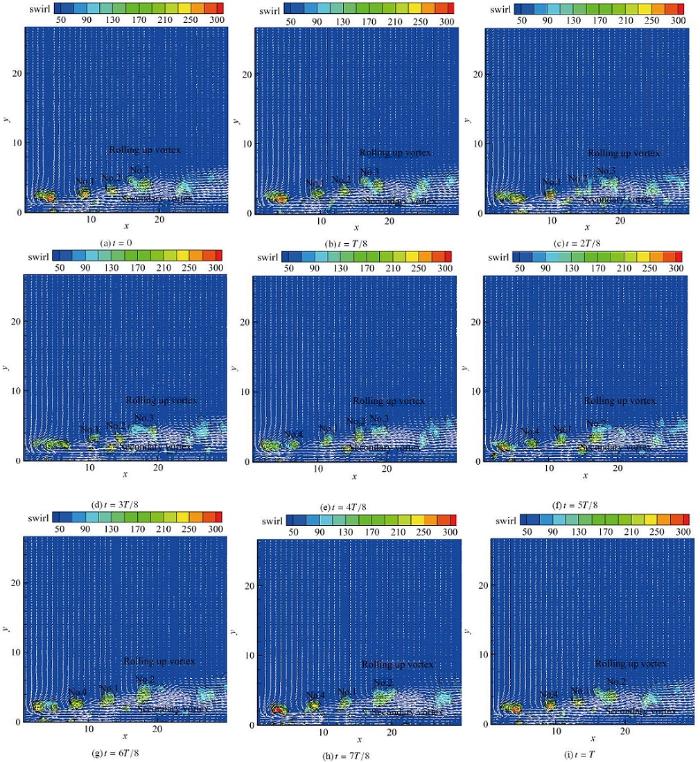
图9 一个周期内旋涡强度的演化过程(
Fig.9 Evolution of swirling strength in one cycle |||||(
为了便于分析, 在图中对每一个卷起涡进行标注. 如图9(a)所示, 刚开始时, 流场中出现1号、2号、3号卷起涡. 随着时间的推移, 3个卷起涡同时向激励器下游运动(如图9(b)
值得注意的是, 一是相邻卷起涡之间的间距近似相等, 表明卷起涡是以固定的频率(109 Hz)向激励器下游发展[41], 这与图8(a)、图8(b)的结果一致; 二是在整个周期内, 涡的融合过程不是特别显著. 这与B点频谱(如图8(b)所示)结果相吻合. 在图8(b)中, 半频的尖峰低于主频峰值.
4 转捩分析
为了进一步理解等离子体激励器诱导湍流射流的产生机制, 对诱导射流的转捩过程进行初步分析. 图10给出了较高电压激励下, 旋涡强度分布随时间变化情况. 从图10可以看出: (1) 当
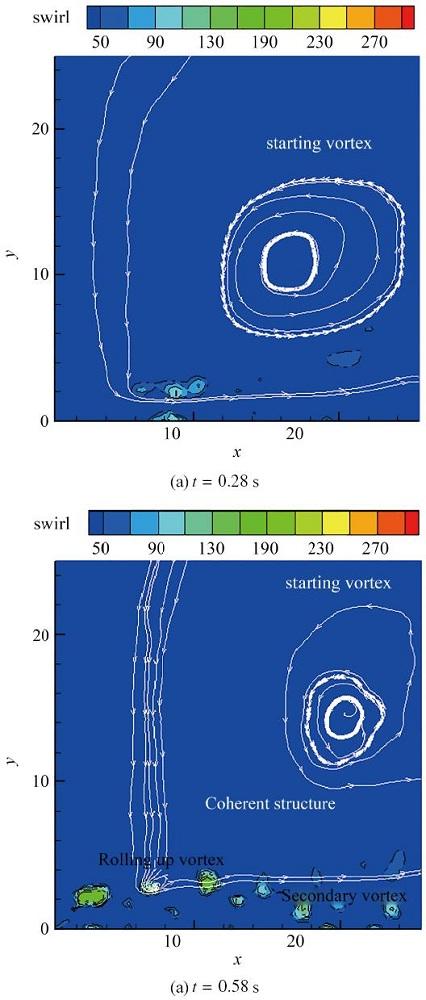
图10 不同时刻下诱导射流旋涡强度分布
Fig.10 The swirling strength distribution at different times
由图10可知, 拟序结构是在一定时刻才出现的, 表明诱导射流经历了从层流到湍流的转捩过程. 图11给出了不同切向位置的均方根脉动速度剖面.
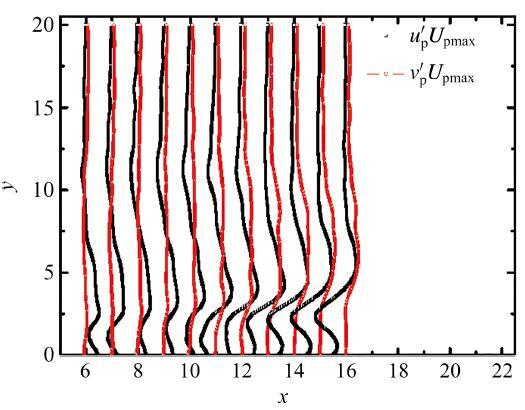
图11 均方根脉动速度剖面沿
Fig.11 Root-mean-squared (r.m.s.) velocity profiles over the surface of flat plate

图12 最大切向速度、最大法向脉动及最大雷诺应力沿
Fig.12 Distributions of the maximum streamwise r.m.s. velocity, the maximum vertical r.m.s. velocity, and the maximum Reynolds shear stress over the surface of flat plate
此外, 最大雷诺应力值沿
5 卷起涡的耗散机制
下面将对卷起涡耗散机制进行初步分析. 由图9可知, 当


6 结 论
本文采用PIV技术, 以非对称布局等离子体激励器为研究对象, 开展了激励器诱导射流特性研究, 分析了激励电压对诱导射流特性的影响, 揭示了诱导湍流射流近壁区拟序结构, 得到以下结论:
(1)等离子体诱导射流有层流、湍流两种类型, 激励电压的高低决定了诱导射流特性. 激励电压较低时, 诱导射流为层流射流, 激励电压较高时诱导射流为湍流射流. 射流雷诺数可以作为判别射流特性的标准之一.
(2)诱导湍流射流包含着卷起涡、二次涡等拟序结构; 首先, 这些涡结构与启动涡不同; 一是产生机理不同; 当激励器刚触发时, 激励器在壁面会产生一股气流, 使得壁面附近压力减小, 在压力差作用下, 激励器上方的空气被吸引到壁面, 从而产生启动涡; 而卷起涡是由于射流剪切层不稳定而卷起形成的; 二是尺度大小不同; 启动涡的尺度远大于卷起涡、二次涡的尺度; 三是运动轨迹不同; 启动涡的运动范围较大, 而卷起涡与二次涡的活动范围相对狭窄, 主要集中在壁面附近; 四是涡的个数不同; 启动涡是单独的大尺度涡结构, 而卷起涡、二次涡是一系列涡结构. 其次, 卷起涡与二次涡都经历了产生、发展及耗散等过程; 在射流起始与发展阶段, 这些涡结构存在固定的频率.
(3)结合切向、法向脉动速度、雷诺应力沿
在近壁区, 拟序结构含有较高的能量. 因此, 控制拟序结构就能控制、提升这些结构蕴含的能量. 下一步将深入研究拟序结构与激励参数之间的关系, 摸清影响卷起涡特征频率的因素, 为提高激励器扰动能力提供科学支撑.
The authors have declared that no competing interests exist.
参考文献
| [1] |
Dielectric barrier discharge plasma actuators for flow control .
|
| [2] |
Review of the investigation on plasma flow control in China .
|
| [3] |
等离子体流动控制研究进展与展望 .
Progress and outlook of plasma flow control .
|
| [4] |
Recent developments in DBD plasma flow control .
|
| [5] |
Aerodynamic modification of a NACA 0012 aerofoil by trailing-edge plasma Gurney flap .
|
| [6] |
等离子体环量控制翼型增升的实验研究 .
Feng Lihao, Wang Jinjun, Choi Ks. Experimental investigation on lift increment of a plasma circulation control airfoil .
|
| [7] |
纳秒脉冲等离子体分离流控制频率优化及涡运动过程分析 .
Frequency optimization and vortex dynamic process analysis of separated flow control by nanosecond pulsed plasma dischage .
|
| [8] |
地面实验模拟高空等离子体流动控制效果 .
High altitude plasma flow control simulation through ground experiment .
|
| [9] |
Numerical simulation on a nanosecond-pulse surface dielectric barrier discharge actuator in near space .
|
| [10] |
低雷诺数下层流分离的等离子体控制 .
Laminar separation control at low Reynolds numbers using plasma actuator .
|
| [11] |
纳秒脉冲表面介质阻挡等离子体激励唯象学仿真 .
Phenomenological modeling of nanosecond pulsed surface dielectric barrier discharge plasma actuation for flow control .
|
| [12] |
新型等离子体主动流动控制器及其诱导流场研究 .
Investigation on new-style plasma active flow controllers and its induced flow field .
|
| [13] |
等离子体流动控制技术原理及典型应用 .
Mechanism and applications of plasma flow control technology .
|
| [14] |
Lift enhancement of an airfoil and an unmanned aerial vehicle by plasma Gurney flaps .
|
| [15] |
Modeling and simulation of plasma gas flow driven by a single nanosecond-pulsed dielectric barrier discharge .
|
| [16] |
A rapidly settled closed-loop control for airfoil aerodynamics based on plasma actuation .
|
| [17] |
轴流压气机等离子体流动控制 .
Plasma flow control of axial compressor .
|
| [18] |
等离子体激励式压气机 .
Plasma actuated compressor .
|
| [19] |
三角翼微秒脉冲等离子体流动控制的试验研究 .
Experimental investigation of delta-wing flow control by microsecond pulse plasma actuator .
|
| [20] |
新型介质阻挡放电等离子体激励器的放电与诱导流动特性实验 .
Experimental research on the discharge and induced flow characteristics of a new dielectric barrier discharge plasma actuator .
|
| [21] |
平流层表面介质阻挡放电等离子体流动控制相似准则验证 .
Verification on similarity of SDBD plasma actuator induced jet for stratospheric flow control .
|
| [22] |
Improving thrust by pulse induced breakdown enhancement in AC surface dielectric barrier discharge actuators for airflow control .
|
| [23] |
等离子体用于三角翼模型流动控制试验研究 .
Experimental investigation on delta wing flow control by plasma .
|
| [24] |
等离子体激励器对微型飞行器横航向气动力矩控制的实验研究 .
Experimental study of directional-lateral aerodynamic moment control of micro air vehicle by plasma actuator .
|
| [25] |
亚微秒脉冲表面介质阻挡放电等离子体诱导连续漩涡的研究 .
Study on continuous vortices induced by sub-microsecond pulsed surface dielectric barrier discharge plasma .
|
| [26] |
Experimental investigation into characteristics of plasma aerodynamic actuation generated by dielectric barrier discharge .
|
| [27] |
Boundary layer flow control with a one atmosphere uniform glow discharge plasma//36th Aerospace Sciences Meeting and Exhibit,
|
| [28] |
Optimization of a dielectric barrier discharge actuator by stationary and non-stationary measurements of the induced flow velocity: application to airflow control .
|
| [29] |
Leading edge separation control using alternating-current and nanosecond pulse plasma actuator .
|
| [30] |
Turbulent boundary layer separation control using plasma actuator at Reynolds number 2 000 000 .
|
| [31] |
Burst-mode frequency effects of dielectric barrier discharge plasma actuator for separation control .
|
| [32] |
Wing flow separation control using asymmetrical and symmetrical plasma actuator .
|
| [33] |
Unmanned air vehicle flow separation control using dielectric barrier discharge plasma at high wind speed .
|
| [34] |
Turbulent boundary-layer control for drag reduction using surface plasma//2nd AIAA Flow Control Conference, |
| [35] |
等离子体气动激励诱导空气流动的PIV研究 .
PIV investigation on flow induced by plasma aerodynamic actuation .
|
| [36] |
等离子体气动激励改善增升装置气动性能的试验 .
Test of high lift system flow control by plasma aerodynamic actuation .
|
| [37] |
Stability of the plane incompressible viscous wall jet subjected to small disturbances . |
| [38] |
The starting vortex in quiescent air induced by dielectric-barrier-discharge plasma . |
| [39] |
|
| [40] |
Mechanisms for generating coherent packets of hairpin vortices in channel flow . |
| [41] |
On vortex shedding from an airfoil in low Reynolds number flow .
|
| [42] |
Flow control over an airfoil using virtual Gurney flaps .
|
| [43] |
Separated shear layer transition over an airfoil at a low Reynolds number .
|
| [44] |
Investigation of the vortex induced unsteadiness of a separation bubble via time-resolved and scanning PIV measurements .
|
| [45] |
A prediction model for separated flow transition .
|
| [46] |
Airplane trailing vortices .
|

/
| 〈 |
|
〉 |